The Best Speeches from Cinema. Part Two
How does a speech in cinema differ from a live speech? In cinema, a speech takes on an artistic form through camera angles, editing, actors' expressiveness, costumes, locations, lighting, and music. All this allows authors to create emotional video that inspires.
In this article, we'll examine historical speeches that inspired and motivated armies for battles, people for rethinking reality, and changed the course of history.
The Dictator's Speech from Charlie Chaplin's Film
I'll start with the film by the genius of the 20th century, Charlie Chaplin's The Great Dictator. It all began with silent cinema. The best in this genre was Charlie Chaplin, who made comedy films. He surpassed himself when he created a tragicomedy about Hitler called The Great Dictator. For this, Charlie Chaplin was threatened with death. The film was so close to the truth that everyone felt it. And even now there's an understanding that this film is about our modernity – one of the signs that we're dealing with a great work of cinematic art.
The culmination of this work was the Dictator's speech. I place it first in my list of the best speeches from cinema. This is a speech by a Nazi dictator who, in the film's finale, realizes his mistake – actions directed against humanity, human values: love, compassion, empathy, which have been cultivated in human hearts for millennia.
The Dictator begins his speech with the words: "I'm sorry but I don't want to be an Emperor. That's not my business. I don't want to rule or conquer anyone." With this, he immediately created a surprise effect: how can a dictator refuse power?! He can! If a revaluation of values has occurred in his consciousness – a complete rethinking of his actions. And after this, the dictator began to speak about these values: about happiness, love, joys of life, about equality and freedom for everyone.
Then the dictator presents a metaphor: "We have developed speed but we have shut ourselves in." After which Charlie Chaplin, through his dictator-hero in 1940, even before the most terrible events of World War II, speaks to every inhabitant of the planet: "To those who can hear me I say 'Do not despair'. The misery that is now upon us is but the passing of greed, the bitterness of men who fear the way of human progress: the hate of men will pass and dictators die and the power they took from the people will return to the people."
How right he was! But unfortunately, even today his words remain relevant. After all, the challenges that Charlie Chaplin speaks about are still encountered in different corners of the planet today, but I'm confident that very soon his prophecy will be completely fulfilled throughout the world. Bravo, Human!
Military Speeches: From Alexander the Great to Maximus
Alexander the Great – the greatest commander in history. According to Plutarch's account, when Alexander heard from the philosopher Anaxarchus about the infinite number of worlds in the universe, he wept and said: "There are so many worlds, and I have not yet conquered even one." Obviously, he was and is one of the most outstanding speakers and inspirers. Only artistic speeches have survived to our days. One such speech is in the film Alexander from 2004.
Alexander began his address to two soldiers who had performed feats earlier, with a question about how they would behave today. And to one soldier whose ancestors had performed heroic deeds. This is a praise technique. After which Alexander addresses everyone, globalizing this technique: "All of you! Honor your homeland and your fathers!" Uniting the army with ancestor-heroes, evoking an emotional connection and motivating them to heroic deeds before battle for the sake of justice.
Maximus's speech before battle in the film Gladiator (2000) is unique for two reasons: humor is rarely used in such speeches, but it's here. And repeated use of the method of uniting with the audience and successful future modeling.
At the beginning of the speech, the hero applies the technique of identifying himself with the audience, addressing the soldiers as brothers: "Fratres! Three weeks from now, I will be harvesting my crops. Imagine where you will be, and it will be so. Hold the line! Stay with me!"
Then he uses humor to create a positive emotion and prepare them for battle:
"If you find yourself alone, riding in the green fields with the sun on your face, do not be troubled. For you are in Elysium, and you're already dead!"
After this follows laughter from the cavalry, and it's time to unite himself with the soldiers again with the memorable conclusion: "Brothers, what we do in life... echoes in eternity."
Political Speeches: Kennedy, Churchill, Lincoln
John Kennedy in the second episode of the series The Kennedys speaks before mothers of fallen war heroes. The future president begins timidly – with formal promises of benefits, which causes surprise and tears in one of the mothers. But Kennedy corrects himself: since his older brother died in the war, and his mother also belongs to this community of mothers of heroes, he appealed to the unifying fact of shared grief and understanding. This emotionally brought John Kennedy closer to the audience and naturally evoked trust and further support.
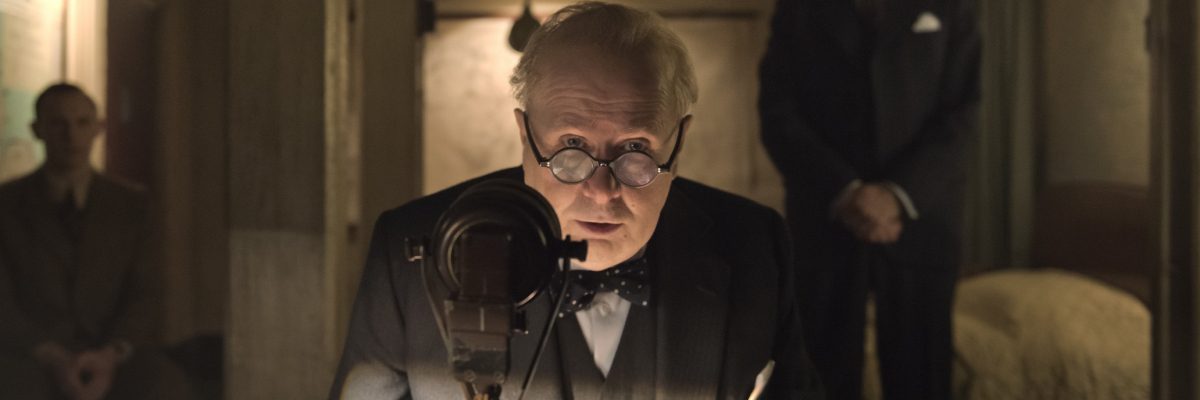
The film Darkest Hour is a piercing depiction of the character of the most famous British Prime Minister, Winston Churchill. This film shows two speeches worth attention. I'll say right away: these speeches are not invented, but completely real.
The first speech is Churchill's radio address (May 19, 1940). Churchill begins with a pause characteristic of him to attract attention. Then he emphasizes the importance of the moment and appeals to a shared need for security and to a shared value – freedom: "I speak to you for the first time as Prime Minister in a solemn hour for the life of our country, of our empire, of our allies, and, above all, of the cause of Freedom."
The second speech is Churchill's speech in Parliament "We Shall Fight on the Beaches" (June 4, 1940). In it, Churchill first appeals to shared past to unite with the audience, then uses a rhetorical technique and appeals to the sense of pride and values of the British: "Even though large tracts of Europe and many old and famous States have fallen or may fall into the grip of the Gestapo and all the odious apparatus of Nazi rule, we shall not flag or fail. We shall go on to the end."
In Steven Spielberg's film Lincoln (2012), there's a moment worthy of attention: debates about introducing an amendment to the US Constitution on the abolition of slavery. The key phrase by Stevens, a member of the House of Representatives, says: "I do not hold with equality in all things, only with equality before the law!" Lincoln's final speech is striking. He appeals to universal human values:
"With malice toward none, with charity for all, with firmness in the right as God gives us to see the right, let us strive on to finish the work we are in, to bind up the nation's wounds, to care for him who shall have borne the battle and for his widow and his orphan, to do all which may achieve and cherish a just and lasting peace among ourselves and with all nations."
Note: Lincoln's concluding words are actually from his Second Inaugural Address (March 4, 1865), one of the most famous speeches in American history.
What can be taken from cinematic speeches?
So, films I recommend watching for developing oratorical skills: The Kennedys, Darkest Hour, Gladiator, Lincoln, The Great Dictator, Alexander.
In conclusion, I draw attention to the fact that the artistic representation of speech in cinema evokes emotions through additional means: colors, angles, makeup, costumes, and music. But in life, we need to be genuine, seek decorations in nature – in everything natural, and expressive means – in ourselves, and then each of our words will have artistic value.
Note: While Churchill's speeches in this article are historically accurate, some quotes from films like "Alexander," "Lincoln," and "The Kennedys" are artistic interpretations created for cinematic purposes rather than exact historical records.
Mykola Ovcharov