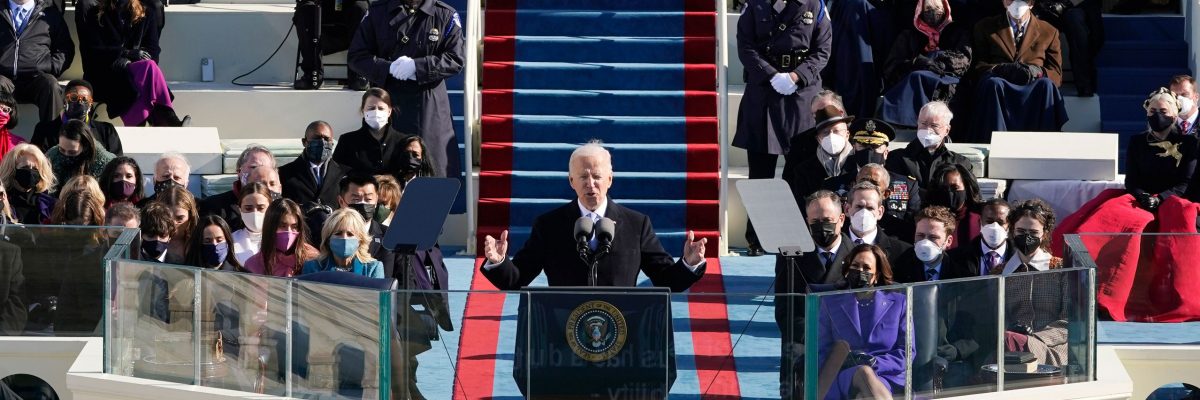
About Joe Biden's Inaugural Speech
Joe Biden was first elected senator in 1972 when he was 29 years old. He tried to run for president three times and achieved his goal only in 2020 at the age of 78. Though he suffered from stuttering since childhood, he independently overcame this ailment. How? By refining his rhetoric daily, which allowed him to deliver his inaugural speech with poise and dignity.
Every newly elected US president faces the same goal – to unite society, divided by America's traditional two-party electoral system, with their inaugural speech. For Joe Biden, this goal became more relevant and important than ever.
The new president structurally built his speech on the basis of two victories and a call for unity for the future.
How did Biden speak about the first victory?
At the beginning of his speech, Joe Biden talks about the first victory – the triumph of democracy. He tries to unite society with the main value of the American state: "This is America's day, democracy's day, a day of history and hope. This is not my triumph, this is democracy's triumph."
After this, Biden several times appeals to shared historical past, which should also evoke a feeling of unity. For over 200 years, Americans have democratically elected presidents and carried out peaceful transitions of power. George Washington was the first to take the oath. The subsequent history of the USA was accomplished thanks to all American people, not any particular president.
The issue of racial equality, for which the American people have been fighting for over 400 years, remains important because it's a matter of justice. Biden reinforced this thesis with a quote from Abraham Lincoln, who signed the Emancipation Proclamation and said that if he entered history, it would be thanks to this act.
Several historical challenges that were overcome through unity were also cited: the American Civil War, the Great Depression, World War II, the September 11 attacks. These examples were given to evoke pride and motivate unity through difficult historical trials that the country and people went through.
What did the second victory mean?
Joe Biden announces that we are looking at a place where Martin Luther King delivered his great speech about a dream. Here, over 100 years ago, women fought for the right to vote. And now we see the first female vice president in US history – Kamala Harris.
After this emotional moment, Biden categorically calls: "Don't tell me something is impossible. Nothing will ever stop democracy. Disagreements should not divide us."
How did the speech call for the future?
At the end of the speech, there was a promise to write a new great chapter in US history with a quote from the anthem: "Century-long efforts and prayers brought us to this day. What will our legacy be? What will our children say?"
And a call to act together for the good of America. And an oath to defend America, the constitution, and the people, which should strengthen trust and support for the new president.
This was a wise speech that demonstrated classic techniques of political rhetoric: appeal to shared values, historical examples of unity, and a motivational call for a common future.
Mykola Ovcharov
January 21, 2021